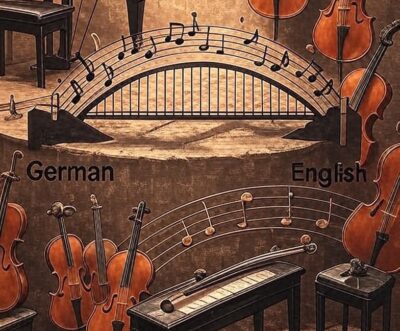
Carrying the Soul Across: Why Song Translation Is So Much More Than Words
I’m often asked: “Can you just translate my German lyrics into English?”
My answer is always the same: “I can’t just translate them. I have to carry the soul across.”
Literal translation and song translation are two completely different crafts. A word-for-word approach usually kills the heart of a German song the moment it lands in English. Suddenly the tender homesickness of “Heimweh” becomes the flat word “homesickness,” the playful warmth of “Schatz” turns into the cold “treasure,” and an entire storyline can shift without anyone noticing — until the artist listens to the English version and says, “Wait… that’s not my song anymore.”
Let me show you what I mean with a real example.
A few years ago I was asked to create an English version of a beautiful German Christmas song. One line in the original went:
„…wenn Kerzenlicht die Kinderaugen tanzen lässt.“
A direct translation would be: “…when candlelight lets the children’s eyes dance.”
It’s grammatically correct, but it’s dead. The magic is gone. In German, the verb “tanzen lässt” gives the light itself the power to make the children’s eyes dance, as if the flame is a loving puppeteer. In English, the same sentence feels stiff and slightly confusing.
So instead I wrote:
“…when candlelight makes the children’s eyes sparkle and dance.”
Suddenly the warmth is back. The flame is still alive, the wonder of a child on Christmas Eve is preserved, and, most importantly, the singer can actually sing it with emotion.
This is the invisible work of a true song translation:
- Protect the core image
Never sacrifice the picture the listener sees in their mind. - Keep the emotional temperature
A word like “Sehnsucht” isn’t just “longing” (too cool). Sometimes it needs “aching,” “yearning,” or even “that sweet pain in the chest” depending on the melody. - Respect the melody’s architecture
German loves long compound words; English loves short, punchy ones. I often have to rebuild the line so it still lands exactly on the same beats and breathes in the same places. - Honour the cultural DNA
A German song about “Waldeinsamkeit” cannot become a generic “loneliness” in English without losing its almost spiritual quality. Sometimes I keep the German word and teach the English listener what it means, because no single English word is big enough. - Stay faithful to the story, not the syllables
If the German lyric tells of a grandfather who walked through snow to bring his granddaughter an orange (a rare treasure in post-war Germany), the English version must still carry that orange, that snow, that love — even if I have to move a phrase to a different bar.
A bad translation creates a new song with the same melody.
A good translation makes the listener feel exactly what the very first German audience felt, even if they’ve never heard a word of German in their lives.
That’s why I never accept a translation job unless the composer or artist trusts me to be more than a dictionary. I become, for a little while, the guardian of their original intention.
If you have a German song that deserves to live in English without losing its heartbeat, reach out.
I don’t translate words. I carry stories across the border, one singing line at a time.
With love and lyrics,
Evelin ♡